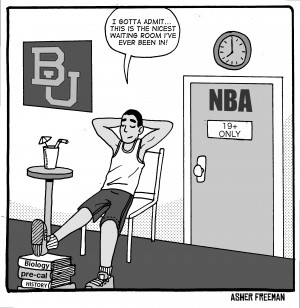
The college basketball season is one of the most exciting times of the year. Fans watch their teams battle to get into the NCAA Tournament, which is filled with Cinderella stories and buzzer-beating 3-pointers. But since the NBA’s 2005 collective bargaining agreement, college basketball has been robbed of its true quality.
In 2005, the NBA changed its rules regarding player eligibility. Commonly referred to as the “one-and-done rule,” all players must meet certain criteria before playing in the NBA. The NCAA usually takes the brunt of the criticism for this, but it is an NBA rule that the NCAA has no control over.
I must first start off by saying that this column is not for everyone. So before you waste your time reading something that does not enhance your quality of life, observe the following rules to weed out those of you to whom my advice does not apply:
If you wake up every morning with clear skin and smooth lips, know your summer itinerary includes a trip to Europe, an internship in New York/LA and a lot of poolside lounging, have the body of a Victoria’s Secret model and Angelina Jolie’s face and get asked out constantly, then stop reading now. To all who meet the above requirements — no hard feelings. We love you. We are happy for you. Keep doing your thing. Cheers.
When the student body president for Northwest Christian University came out, he sent shockwaves throughout his campus and Christian community. He did not come out as a homosexual, but as an atheist.
In a column published by the Beacon Bolt, the student newspaper for NCU, senior Eric Fromm announced to the student body that he was an atheist while calling out the judgmental peers that shunned, or worse, attacked him verbally.
Competitive athletes have been confronted with an impossible task of playing it hard and playing it safe, and professionals and spectators need to realize what makes football so entertaining is the threat of injury.
As much as I agree with the spirit of Danny Huizinga’s Nov. 19 column titled “Employer religious freedom at risk with Obamacare laws,” his argument is difficult to swallow.
“Since when are business owners not allowed to make the decisions for their company?’” Huizinga rhetorically asks. The answer is that business owners have never had free reign over their companies.
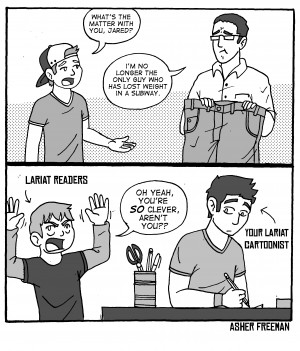
Thirty squats might be your exercise for the day. Thirty squats could also get you a ride on the subway. At least, that’s the case in Russia.
A vending machine has been set up in a Moscow subway station that would allow people to buy a subway ticket by doing 30 squats. A ticket would normally cost 30 rubles, or 92 cents.
The Supreme Court just heard arguments for Greece v. Galloway, a case about legislative prayer and religious freedom. But the debate shouldn’t stop there.
The court should also agree to hear Hobby Lobby v. Sebelius, a high-profile case that carries widespread implications for religious business owners across the country.
Susan Galloway and Linda Stephens, in the town of Greece, N.Y., filed a lawsuit against the town complaining that they and other residents that attend council meetings are a captive audience because the council opens every meeting in prayer.
They contend that because nearly every prayer offered was overtly Christian, that the town was endorsing Christianity, which is viewed as a violation of the First Amendment.