By Rhea Choudhary | Staff Writer
Cybersecurity is a field facing significant national and statewide talent shortages, but Baylor’s new initiative aims to help just that.
Baylor, through its leadership of the Central Texas Cyber Hub, launched the K-12 Cyber Security Pathways Program, a new initiative to prepare high school students for immediate entry into the cybersecurity workforce or continued education.
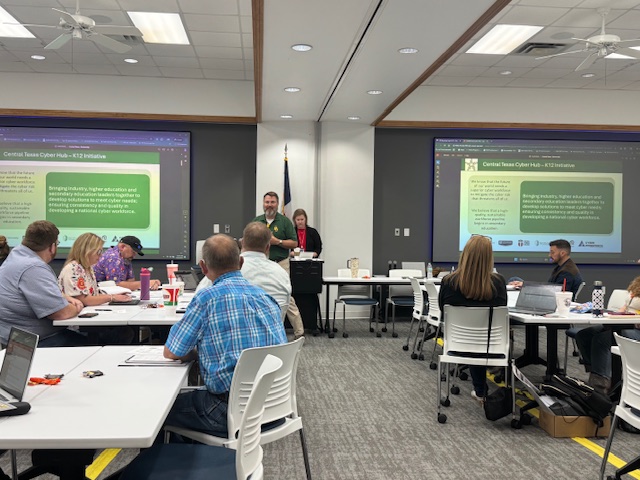
The program officially launched Dec. 16 with an inaugural meeting of the first cohort of eight Central Texas school districts that will begin offering student coursework in fall 2026. Participating districts include Bosqueville ISD, Chilton ISD, Hubbard ISD, Marlin ISD, McGregor ISD, Moody ISD, Morgan ISD and West ISD.
The first cohort of ninth-grade students will enter the program in the fall. Curriculum planning, student enrollment and instructor training academies will take place throughout spring and summer 2026. Additional school districts will be added annually through an open application process.
While the CSPP is one of several initiatives housed within CTCH, planning and implementation moved quickly from concept to launch, according to David Grover, senior director of cyber initiatives in the Office of Innovation and Economic Development at Baylor.
“We started discussions on what this K-12 program might look like in August, knowing we had a very short timeline,” Grover said. “In essentially one year, we’re going from those first conversations to the first students sitting in a cybersecurity classroom.”

The CSPP directly responds to a growing cybersecurity workforce shortage. According to Cyberseek, there are approximately 514,000 open cybersecurity positions nationwide, including more than 42,000 in Texas alone.
“What we’re really doing is establishing a workforce pipeline, and that pipeline needs to start in the K-12 space,” Grover said. “We want students excited about cybersecurity early so they can see what’s possible and be prepared to meet industry needs.”
Students who complete the program will graduate with three industry-recognized certifications from CompTIA Tech+, CompTIA Network+ and CompTIA Security+, qualifying them for entry-level cybersecurity roles immediately after high school. By partnering with community colleges, students can also transfer coursework for college credit, seamlessly transitioning into opportunities in higher education.
“We’re not saying there’s one right path,” Grover said. “Students can go directly into the workforce, pursue a community college degree, attend a four-year university or continue on to graduate education. Our role is to give them opportunities they may not otherwise have.”
President Linda Livingstone emphasized the initiative as a key investment in Central Texas, noting that it equips students with the skills they need for college or work.
“With thousands of cybersecurity jobs unfilled nationwide, this initiative represents an important investment in our region’s talent pipeline and reflects our commitment to serving our communities through education and workforce development,” Livingstone said.
A standout feature of the program is its no-cost structure for participating school districts. Initial curriculum costs for the first cohort are funded through industry partnerships, allowing districts to launch the program without financial burden and transition to a sustainable funding model in subsequent years.
“By having industry partners fund that first year, the school districts are able to participate without cost,” Grover said. “At the end of the year, they can then use state career and technical education reimbursements to support future years, making the program self-sustaining.”
CTCH leaders are also pursuing additional industry, state and federal funding to support extracurricular opportunities, including competitions and field trips, helping further reduce costs for students and families.
“Our goal is to remove as many barriers as possible, not just for schools but for students themselves,” Grover said.
Another goal of the program is serving rural Central Texas communities, where access to high-tech career pathways is often limited.
“Rural schools face different challenges than urban districts,” Grover said. “This program gives students in smaller communities the chance to pursue high-skill, high-paying careers that may not otherwise be available to them.”
CTCH strengthens the region’s cybersecurity network by combining academic, industry and government partners to invest in their work. This program’s key partners include Central Texas College in Killeen, McLennan Community College in Waco, Scinary Cybersecurity, CyberWorkforce and Education Service Center Region 12.
“Central Texas College is proud to partner with Baylor University through the Central Texas Cyber Hub to help students see a future in cybersecurity early in their high school learning experience,” said Dr. Tamara Clunis, chancellor for instruction and workforce education at Central Texas College. “Through this partnership, we’re creating practical pathways into a field with urgent talent needs.”
Livingstone expressed her gratitude for the collaboration, which accelerated the program’s success.
“I am thankful for Baylor’s academic and industry partners in the Cyber Hub, including Central Texas College and McLennan Community College, whose collaboration with Baylor is expanding and strengthening opportunities for students,” Livingstone said.
Grover said the Cyber Hub remains open to new partnerships as the program expands.
“Industry is ultimately who will hire these students,” Grover said. “When partners are involved from the beginning, students are better prepared to step confidently into the workforce the moment they graduate.”